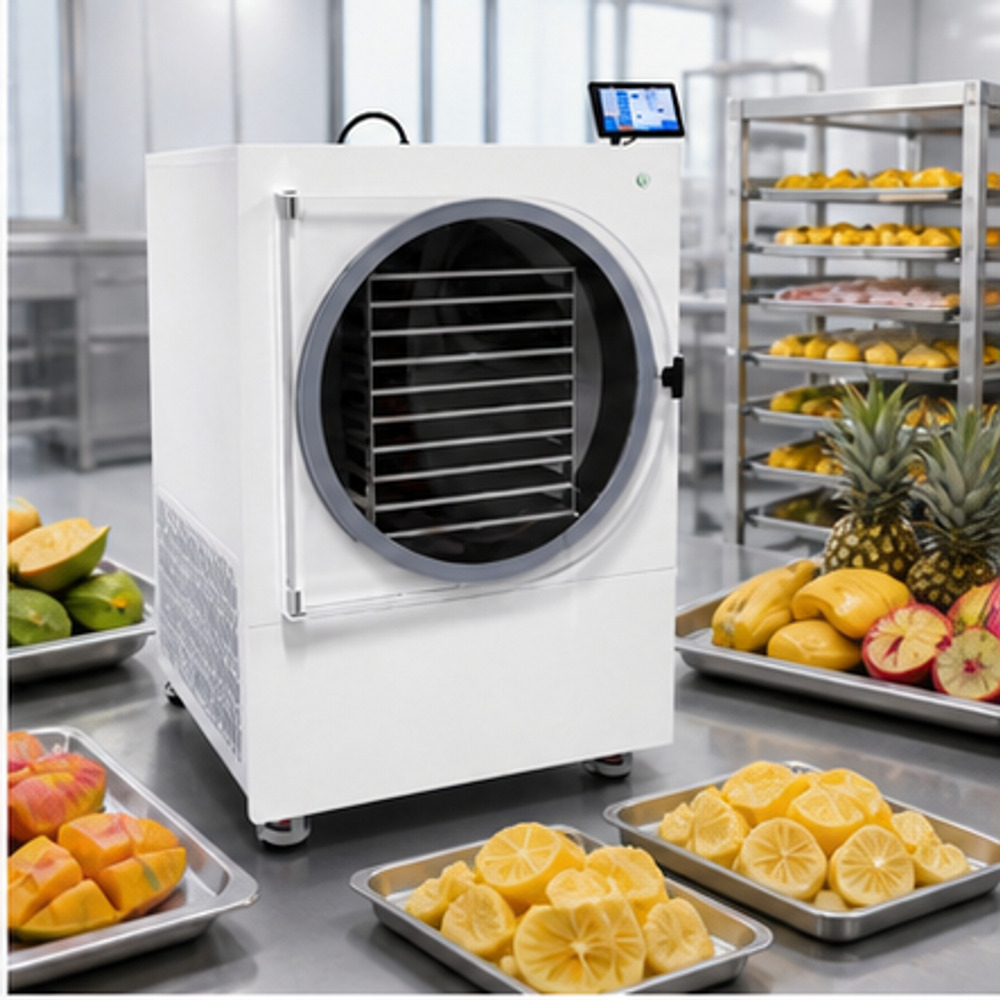
The useful dividing line between a small and commercial food freeze dryer is not simply physical size. It is the way the machine fits your recipe development, selling schedule, labour, room layout, packaging capacity, and expected weekly output.
Choose a small food freeze dryer when learning and flexibility matter
Small H Series models suit recipe trials, market testing, farms, specialty food makers, culinary development, small pet-treat brands, and businesses that need several product changes. They make it practical to learn how slice thickness, pre-freezing, tray depth, and endpoint affect texture and cycle time without committing to a large production load.
- SJ-05H: reference 5–7 kg fresh load, 0.48 m² usable tray area.
- SJ-08H: reference 8–12 kg fresh load.
- SJ-10H: reference 10–15 kg fresh load, 0.973 m² usable tray area.
- SJ-15H: reference 15–22 kg fresh load, 1.45 m² usable tray area.
- SJ-20H: reference 22–33 kg fresh load.
Models are sold as specific condenser configurations. Compare the exact -40°C, -55°C, or -60°C SKU rather than treating a model family as one machine.
Choose a commercial food freeze dryer when repeatable throughput matters
The commercial H Series—SJ-30H, SJ-35H, and SJ-50H—is intended for food businesses moving from trials into planned production. At this stage, the buying decision should include staging racks, pre-freezing, loading and unloading time, packaging rate, cleaning access, ventilation, electrical service, and the number of batches expected per week.
| Question | Small H Series | Commercial H Series |
|---|---|---|
| Primary use | Recipe development and small-batch sales | Regular commercial food production |
| Best comparison metric | Flexibility plus usable tray area | Throughput plus total workflow capacity |
| Site planning | Voltage, ventilation, workspace, drainage | Utilities, receiving, material flow, packaging, unloading |
| Buying path | Retail EXW order or DDP quotation | Configuration review and delivered quotation recommended |
Use your real product to confirm the step up
Run or estimate a representative load, then record starting weight, finished weight, layer depth, cycle time, acceptable dryness, and packaging time. Those figures reveal whether the next constraint is tray area, drying time, labour, pre-freezing, or packaging—not just nominal kilograms.
Shop small food freeze dryers Shop commercial food freeze dryers